books
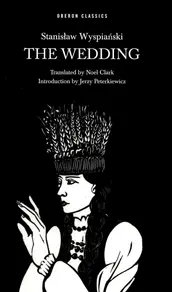
The Wedding
[3.5] This translation of a major classic of Polish theatre - also the basis for a 1973 Andrzej Wajda film - works fine in English, and its verse scans perfectly well, even if it doesn't possess the heft of greatness that the original presumably has. I'd taken too much notice of the only previous Goodreads review of this translation, a damning review by an unfamiliar user, who was frustrated by an edition with layout issues. I assumed it was a dreadful version not worth any effort to obtain. But just a week or two later, I happened to have a look at Scribd, a couple of years since I last subscribed. Not only has their policy changed back to unlimited books, but they seem to be at least as good as they were for obscure books from smallish presses. I found several short translated Polish classics I'd wanted to read, but which I'd been resigned to not reading due to price and the probability of their being slow to sell on again. Regardless of my preconceptions about Clark's translation, it was the shortest of these books, and this was probably my only chance to read the play at little to no cost, so I started it first - and was very pleasantly surprised. The introduction by the late Jerzy Peterkiewicz, an authority on Polish poetry, provided much-needed context for a work that could have otherwise been opaque. (Even those who don't usually read introductions first should read this one, unless they already have good knowledge of Polish cultural history.) Among other things, he explains that circa 1900, there was something of a fashion for young male Kraków intellectuals to go back to the land and marry peasant girls (as per the wedding in the play). Closer connections with, and respect for, the peasantry were seen as an important in Polish nationalism and ideological resistance to the rule of the Austro-Hungarians - in this southern area of Poland - and Russia - most of the rest of the country. (I've also been listening to an audiobook about Stalinism recently, and was struck by the contrast between the mostly-idealised view of these Polish peasants, and the anathema with which Russian peasant culture was regarded by some of these characters' Russian contemporaries and their children.)This was the era of the Young Poland art and literary movement (c.1890-1918) which I’ve still to learn more about; it incorporated tendencies that readers steeped in Western European literature are used to seeing as separate movements: decadence, aestheticism, Symbolism, neoromanticism and modernism. I've been enjoying the pragmatic attitudes of its realist predecessor, Positivism, in the brilliant doorstopper novel The Doll by Bolesław Prus (think an urban bourgeois Tolstoy who's nicer about his characters) and I feel at home with Positivism to an extent I wouldn't have at many times when I was younger. But I still have plenty of sympathy for a story featuring back-to-the-landism and historical ghosts, things that have appealed to me for a long time. The trend for this type of marriage, the nationalism and the shift away from realist art provide three basic keys to making sense of this play, but it also felt like a work packed with detail I was not equipped to interpret. (Detail which has been observed and underlined by generations of teenagers in Polish schools.) There must be influences I didn’t notice: I've hardly read any German classics beyond Young Werther, and German is just one of the literatures which apparently was in dialogue with Wyspiański’s work. Among the folkloric details, there is a Straw Man, quite different from the English phrase: here he presumably has some connection to corn sprites, but is a more ambigous entity... what exactly? A coincidental recent viewing of Krzyzacy, the 1960 film adaptation of a classic historical novel published the year before this play, meant I had one more reference for peacock feathers in Polish culture (there, a villainous knight is identified by them) than just their appearance on the men's Krakowiak folk costume hat (also seen in the film adaptation of The Wedding) but the repeated mention of peacock feathers in this play, and the meaning of this, is exactly the sort of thing which needs good annotation. (There are no footnotes or endnotes in this edition.) You can't find out about that easily online (or in an encyclopaedia - this translation is from 1998), unlike the paintings of Matejko, Ruisdael or Stanisławski. (I love the feeling of cultural reorientation in reading translated works, placing oneself elsewhere in the world and looking around, like the Google Maps pegman figure - and these artists, previously unfamiliar to or forgotten by me, but important in Wyspiański‘s world, were part of that experience.)The play is about ideas that relate to real life – but it’s not a realist play. On the page, the verse, in short scenes - as characters in effect recite a poem between them - makes it look heavily stylised, although many lines in the English translation are enjambed, avoiding the dreaded sing-song sound. The film makes it evident how conversational some dialogue can be, while still retaining musicality; and it shows who’s from where (on the page, there are a lot of characters to keep track of in a short time), and that, for instance, a peasant girl didn’t just use Lohengrin as a metaphor. The unreal is more in content than in form. The spirits of the land accept a casual, drunken invitation to manifest. It’s a charged, life-altering night, as in A Midsummer Night’s Dream or Miss Julie - although set in autumn, and its electricity is political, not romantic or sexual. It’s a shame The Wedding doesn’t seem to be thought of as a ghost story, or as fantasy – I guess staid school approaches do for that. I felt there were plenty of tendrils running between this and ghostly English landscape-mysteries books of my childhood - which themselves have similarities to English horror stories of the early 1900s; and Wajda’s adaptation makes the appearance of the Straw Man look very 1970s folk-horror.I'm grateful to this review of the French translation, by Czarny Pies, for pointing out the possibility of thinking in historical chronological order of the ghosts which appear overnight - they conjure several occasions on which Poles, or certain types of Poles, fought oppressing powers, foreign or class-based; considering them in that right order helped make sense of the play after reading. The meeting or clash of classes and their cultures was initially, more interesting to me than the Polish independence theme. Fashionable intellectuals have, periodically, been taken with the idea of returning to a supposedly wholesome rural idyll, at least since the Elizabethan era of pastoral poetry (and I’ve a very faint memory that Romans or Greeks may have had same)… then there was the the 18th century fashion for the Georgics; Marie Antoinette; the Romantics; the Arts and Crafts movement and Wyspiański’s Polish contemporaries; then the hippies; and recently, another resurgence. But I think The Wedding is the earliest work I’ve seen interrogate it – albeit obliquely. The gentlemen from the city are occasionally laughed at; the bride’s female relatives question whether she’ll be happy; and the peasants are certainly not always friendly. Wyspiański was himself married to a peasant woman, and perhaps this is why his characters’ opinions sound more real than the utterances of deferential, red-cheeked rustics and similar rural caricatures in British fiction by city authors romanticising the countryside circa 1900. Unfortunately there are quite a few anti-Semitic lines in the play, especially the first half. An older male character with plenty to say is named only 'Jew'. (Several of the Catholic male main characters do not have first names either and are named only by their social role, e.g. Groom, Poet, Journalist, but these still give them more individuality). His daughter, like Jessica in The Merchant of Venice, is, however, allowed to be part of the world of the gentile characters and is desirable and interesting to some of them. (She is a formidably well-read woman who would fit perfectly in a post-WWII Jewish-American film or novel, and although she is fictional, I kept hoping she got out of Poland before 1939.) The ethnically mixed environment of pre-war Poland is frequently described as multicultural, but to the casual reader that word may suggest something more amicable and egalitarian, rather than the pattern of rising and falling tensions, and varied, but by modern standards often high, level of prejudice from Catholics, which is hinted at in The Wedding. I watched the film the same day I finished reading the play, and most of the way through, I thought it would only display nice costumes and make it more obvious in each scene which characters were from the city and which from the country. But perhaps the appearance of one of the ghosts nudged a memory of Macbeth. As one of the apparitions was on screen, a fourth 'key' occurred to me. For a minute I transposed the whole story to Scotland at some indeterminate time, and, because the Scottish independence movement is something I've seen grow over many years, heard discussed in the news, listened to people talk about it first-hand, the aesthetics and ideas in the play gained a new dimension. I perceived the examination of what Polishness means, which I couldn't honestly see before, despite having read it was there. I’m not sufficiently rooted in one place myself to be able to feel the same depth of attachment to a region or country – but having met enough of those who do, I could try and imagine myself into their shoes. I could feel how deeply emotional this play was and why people might love it. If you haven't lived in a country like the UK, Spain or Canada, which has an area with an independence movement, I'm not sure one might replicate this. Despite having Polish ancestry, I've never personally *felt* the sense of it as a country that's uniquely hard-done-by, an idea prominent in its traditional culture : it's better off than, for example, Romania; and less small and vulnerable, and with a longer duration of independence, than the Baltic States. Perhaps it was that sentiment - out of step with Polish tradition - or last year's events in Catalonia, or my current liking for the circumspect Positivism, but I'm inclined to a, perhaps ironically, Positivist interpretation of The Wedding. One version of the play's message is that the country is paralysed and unable to act for its own independence, whilst the intelligentsia lose themselves in pleasant distractions and lifestyle choices which don't mean as much as they think they do. But I saw this same situation as saving the characters from a bloody and repressive fate at the hands of one or both governing empires.The translation may flow well in English, and the use of the occasional archaic word, such as ‘helve’, displays a wide vocabulary consistent with 120-year old English poetry – but as I browsed another book of Polish plays I’d been wanting to read for a while, from the same publisher and translator, I realised I may have been reading Noel Clark a lot more than I’d been reading Stanisław Wyspiański. His version of Aleksander Fredro’s 1834 verse play Revenge has a voice very similar to that of The Wedding - although Wyspiański's work was said to be strikingly innovative on first performance. So whilst Clark communicates meaning in good verse (and translating poetry is a special skill), there is still something missing, something that shows the distinctiveness of the individual, original writer. Nonetheless, I found both play and film interesting, and wish there was more to read about the play in English.